
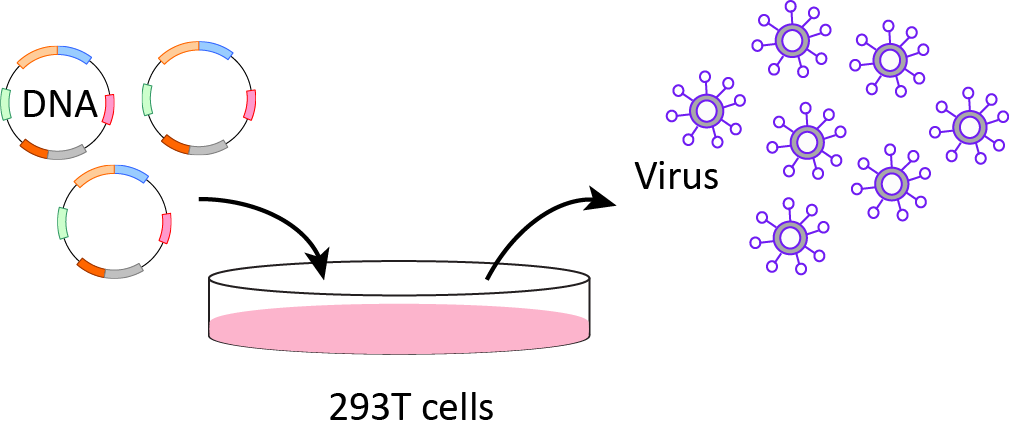
Once the lentiviral vectors are ready, Biosettia may package and titer the lentiviruses within 7 business days. We offer the service to package the 2nd and 3rd generations of lentiviral vectors, and the packaged viral genome sizes (5’LTR-to-3’LTR) may be up to 15-kb. The lentiviruses are produced in a serum-free medium and the carry-over FBS from the 293T transfection should be less than 0.1%.
Lentivirus Production and Titering
Lentivirus titering by serial dilution and antibiotic selection (colony formation titering) is not only time consuming, and also limited by the vector design. For example, the antibiotic-resistant genes expressed from a weaker promoter or IRES may form less colonies therefore the virus titers are under estimated. Same thing for using fluorescence proteins like GFP and RFP as reporter to titer the viruses, the promoter strength plays an important role and the virus titers varied not due to the copy numbers of the viral genome but the detectable level of GFP/RFP by the flow cytometry. On the other hand, p24 ELISA or viral RNA quantitative PCR may be overestimating the virus titers since these methods cannot rule out the non-functional viral particles.
Biosettia have developed a functional virus titer. The H1299 cells are transduced by the lentivirus samples and the total DNA including host genomic DNA and reverse transcribed lentiviral cDNA are isolated around 16 hr post-transduction for real-time PCR analysis. The Bsd-resistant lentivirus pre-titered in H1299 cells by colony formation titering is used as copy number reference to determine the functional titers of the lentivirus samples. Biosettia’s titering method determines the lentiviral copy numbers in the transduced H1299 cells which is more accurate than other titering methods mentioned above.